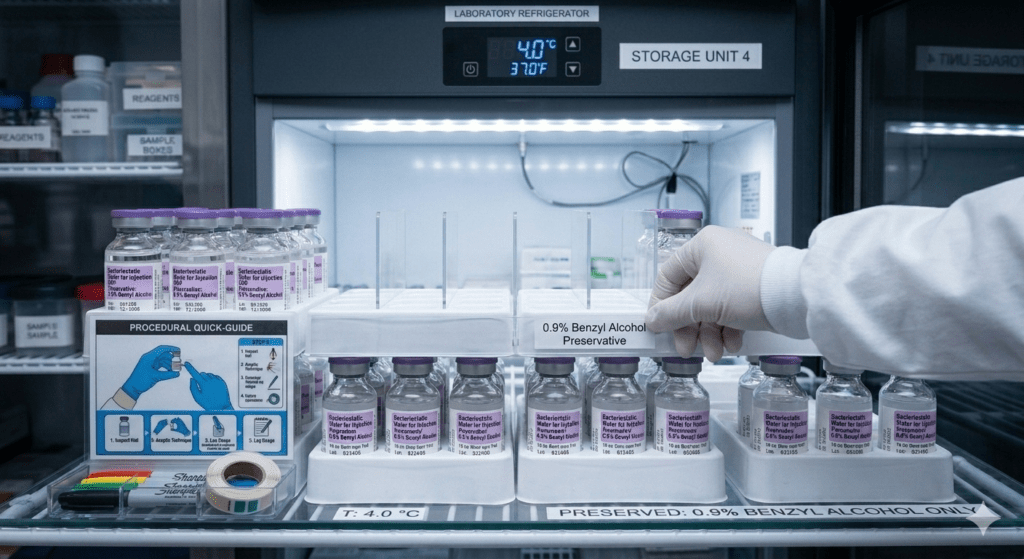
Bacteriostatic water is widely recognized in laboratory environments because of its unique formulation and multi-dose capability. One of its most important components is benzyl alcohol, a preservative that gives this sterile solution its bacteriostatic properties.
Many people researching laboratory solutions ask:
Why does bacteriostatic water contain benzyl alcohol?
The answer is related to maintaining product usability during repeated access. Unlike sterile water that contains no preservative, bacteriostatic water includes 0.9% benzyl alcohol, which helps inhibit bacterial growth after the vial has been opened.
This characteristic makes bacteriostatic water a commonly selected solution for research environments where controlled preparation procedures require flexibility. However, benzyl alcohol does not replace proper laboratory practices. Maintaining clean handling procedures, appropriate storage, and responsible use remains essential. For laboratories searching for reliable research supplies, Bacteriostatic Water Lab provides bacteriostatic water products and related laboratory materials. Bacteriostatic WaterLab Products → https://bacteriostaticwaterlab.com/shop/
Benzyl alcohol is an organic compound commonly used as a preservative in certain laboratory and pharmaceutical formulations.
In bacteriostatic water, benzyl alcohol is present at a concentration of 0.9%.
Its primary purpose is to help reduce bacterial growth potential after the container has been opened.
The addition of benzyl alcohol creates a difference between:
Bacteriostatic water with benzyl alcohol:
Understanding the role of each component helps researchers select suitable laboratory solutions.
The main reason benzyl alcohol is added is to provide preservative properties.
When a sterile vial is opened and accessed multiple times, there is always a possibility of introducing microorganisms from the surrounding environment.
Benzyl alcohol helps slow the growth of many bacteria that may be introduced during normal handling.
The preservative allows bacteriostatic water to support repeated withdrawals when handled according to appropriate procedures.
Laboratories working with multiple preparation steps may benefit from the convenience of a multi-dose solution.
Compared with single-use solutions, multi-dose options may help laboratories reduce material waste depending on workflow requirements.
Benzyl alcohol works by creating conditions that make bacterial growth more difficult.
It is classified as a bacteriostatic agent because it helps inhibit bacterial multiplication rather than acting as a complete sterilizing agent.
This distinction is important.
Benzyl alcohol:
✔ Helps slow bacterial growth
✔ Supports preservation after opening
✔ Provides additional protection during repeated access
Benzyl alcohol does not:
✘ Sterilize contaminated materials
✘ Replace proper laboratory procedures
✘ Make improper handling acceptable
Researchers must continue following established laboratory practices. For scientific information about pharmaceutical ingredients and biomedical research, researchers can explore: PubMed Central (PMC)
The presence of benzyl alcohol creates the main difference between these two solutions.
| Feature | Bacteriostatic Water | Sterile Water |
|---|---|---|
| Benzyl Alcohol | Contains 0.9% | No benzyl alcohol |
| Preservative | Yes | No |
| Multi-dose capability | Designed for repeated access | Generally limited |
| Laboratory flexibility | Higher | Lower |
| Handling requirements | Requires sterile technique | Requires sterile technique |
The correct choice depends on the specific research requirement.
Bacteriostatic water containing benzyl alcohol is commonly associated with research environments requiring sterile preparation solutions.
Potential laboratory applications include:
Researchers may use bacteriostatic water as part of controlled preparation procedures.
Biotechnology laboratories often require reliable sterile materials to support experimental workflows.
Consistent laboratory supplies help researchers maintain organized processes.
Research facilities may use specialized sterile solutions as part of development and analytical activities.
The exact application depends on laboratory protocols and requirements.
The addition of benzyl alcohol gives bacteriostatic water several practical advantages for laboratory environments.
While the preservative does not replace sterile techniques, it provides additional functionality that makes this solution useful in research workflows.
One of the main advantages of bacteriostatic water with benzyl alcohol is its ability to support multi-dose use.
Because benzyl alcohol helps inhibit bacterial growth after opening, researchers can access the same vial multiple times when following appropriate handling procedures.
This can be useful in workflows where repeated preparation steps are required.
Benefits include:
Research environments often focus on improving efficiency and managing resources effectively.
Multi-dose solutions may help reduce unnecessary waste compared with solutions intended for single access.
By selecting appropriate laboratory supplies, researchers can better organize inventory and preparation procedures.
Different research projects have different requirements.
Bacteriostatic water provides flexibility because it can support procedures where repeated withdrawals are needed.
This flexibility can help laboratories:
Although benzyl alcohol provides preservative properties, proper storage and handling remain essential.
Correct storage helps maintain the quality and reliability of bacteriostatic water.
Laboratories should always follow product-specific storage instructions.
Recommended practices generally include:
Before accessing a vial, researchers should inspect the product carefully.
Do not use products showing:
Product inspection is an important step in maintaining laboratory quality.
Benzyl alcohol helps inhibit bacterial growth, but it does not replace proper sterile technique.
Researchers should continue to follow laboratory procedures, including:
Responsible laboratory practices are important when handling any research material.
Researchers should consider:
Every research environment may have specific procedures regarding:
Following internal protocols supports consistent laboratory operations.
Laboratory personnel should follow safety requirements established by their organization.
This may include:
Many laboratories maintain documentation related to:
Proper documentation improves organization and traceability. For general laboratory safety information, researchers can explore educational resources from: Occupational Safety and Health Administration (OSHA)
Selecting a trustworthy supplier is an important step when purchasing laboratory supplies.
Researchers should consider several factors before choosing a product.
Reliable suppliers should provide clear information about:
Clear information allows researchers to make informed decisions.
Proper packaging helps protect laboratory products during storage and transportation.
Important features include:
A dependable supplier should provide:
Bacteriostatic Water Lab offers laboratory-focused products designed for research environments.
Bacteriostatic water contains benzyl alcohol because it acts as a preservative that helps inhibit bacterial growth after the vial has been opened.
Bacteriostatic water typically contains 0.9% benzyl alcohol as a preservative.
No. Benzyl alcohol helps inhibit bacterial growth but does not sterilize contaminated materials or replace proper laboratory techniques.
The presence of benzyl alcohol allows bacteriostatic water to support repeated withdrawals when appropriate sterile handling procedures are followed.
No. Sterile water does not contain preservatives, while bacteriostatic water contains benzyl alcohol.
It should be labd according to manufacturer instructions in a clean environment protected from unsuitable temperatures and direct exposure.
No. Proper sterile handling remains necessary even when using bacteriostatic solutions.
Researchers should select reliable laboratory suppliers that provide clear product information and research-focused products.
Bacteriostatic water with benzyl alcohol is an important laboratory solution because of its unique formulation and multi-dose capabilities.
The addition of 0.9% benzyl alcohol provides preservative properties that help inhibit bacterial growth after opening, making it suitable for certain research workflows where repeated access may be required.
However, proper storage, careful handling, and established laboratory procedures remain essential.
Understanding the role of benzyl alcohol helps researchers better understand why bacteriostatic water differs from standard sterile water and why it is widely used in research environments.
For high-quality laboratory supplies, researchers can explore products available through Bacteriostatic Water Lab. Shop Bacteriostatic Water Lab Products https://bacteriostaticwaterlab.com/shop/