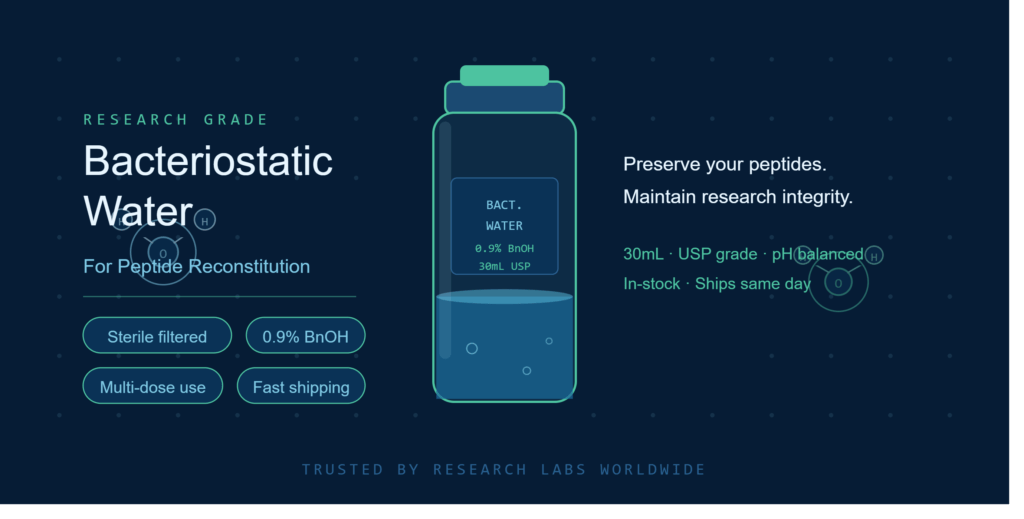
Bacteriostatic water (BW) is sterile water for injection that contains 0.9% benzyl alcohol as a preservative. Unlike standard sterile water, it inhibits bacterial growth, making bacteriostatic water for peptide reconstitution a commonly discussed option in research workflows involving lyophilized (freeze-dried) peptides. This formulation can support repeated access to a vial when researchers follow appropriate sterile handling procedures.
Peptides are highly sensitive compounds. When reconstituting them for research use, the solvent you choose directly affects:
| Bacteriostatic Water | Sterile Water for Injection | |
|---|---|---|
| Preservative | 0.9% benzyl alcohol | None |
| Multi-dose use | Yes | No (single use only) |
| Best for | Peptide reconstitution, proteins | Single-injection compounds |
| Shelf life after opening | Extended | Discard immediately |
| pH | ~5.0 (buffered) | ~5.5–7.0 |
For most peptide reconstitution protocols in a research setting, bacteriostatic water is the correct choice.
Researchers can use the Peptide Reconstitution Calculator as a supplementary mathematical reference when working with bacteriostatic water for peptide reconstitution. The calculator helps determine the resulting concentration based on the total research material amount and the volume of bacteriostatic water entered.
Concentration = Total Amount ÷ Bacteriostatic Water Volume
Enter the relevant laboratory values into the calculator to simplify concentration calculations and support consistent research documentation.
Note: The Peptide Reconstitution Calculator is provided for laboratory and research reference purposes only. It does not provide medical dosing recommendations or replace compound-specific documentation, safety requirements, or established laboratory protocols.
Not all bacteriostatic water is created equal. For reliable research results, look for:
How much bacteriostatic water do I use per mg of peptide?
Most research protocols use 1–2mL per 5mg of peptide, yielding a 2.5–5mg/mL concentration. Your specific protocol may vary — always consult your peptide’s data sheet.
Can bacteriostatic water be used more than once?
Yes. The 0.9% benzyl alcohol preservative maintains sterility across multiple needle punctures, which is precisely why it is preferred over plain sterile water for peptide work.
How long does reconstituted peptide last?
When reconstituted with bacteriostatic water and labd refrigerated, most peptides remain stable for 4–6 weeks. Conditions vary by compound — always verify with the specific peptide’s technical documentation.
Is bacteriostatic water the same as saline?
No. Saline (0.9% sodium chloride) is a salt solution. Bacteriostatic water contains no salt — only purified water and benzyl alcohol as a preservative.
We manufacture our bacteriostatic water to USP standards, sterile-filter it, and package it in sealed multi-dose vials for professional research environments. We ship same-day on orders placed before 2pm, with discreet and secure packaging.
Order Now → View Lab Supply Catalog
For research use only. Not intended for human or veterinary use.
Sign up and We'll Generate a Personal VIP Coupon Code That's Yours For Life — No Expiry, No Limits - Use it on Every Order.