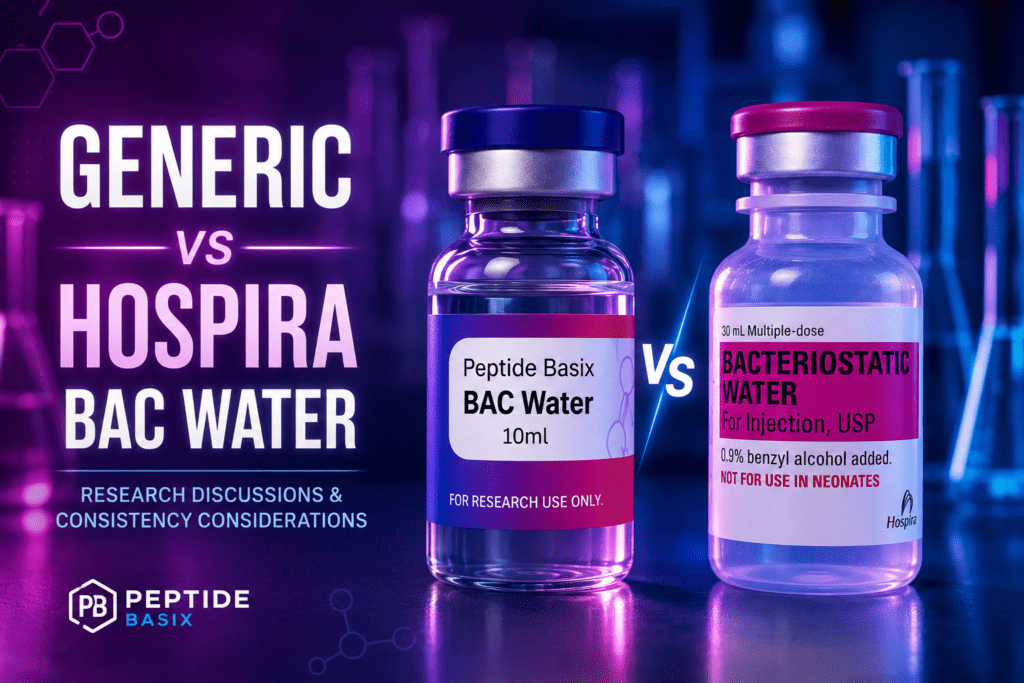
When purchasing laboratory supplies, researchers often compare different product options before making a decision. One common comparison is Hospira bacteriostatic water vs generic options.
Bacteriostatic water is a sterile solution containing 0.9% benzyl alcohol, which acts as a preservative to help inhibit bacterial growth after opening.
Both branded and generic bacteriostatic water products may serve similar purposes in research environments, but differences can exist in areas such as:
Understanding these factors helps researchers make informed purchasing decisions based on their laboratory requirements.
For research-focused laboratory products: Explore Bacteriostatic Water Products →https://bacteriostaticwaterlab.com/shop-bact-water/
Hospira is a well-known pharmaceutical manufacturer that has historically produced various sterile solutions and healthcare products.
Hospira bacteriostatic water is recognized because of its established pharmaceutical manufacturing background.
Like other bacteriostatic water products, it contains:
The product is commonly recognized in healthcare and laboratory discussions because of its brand history.
Researchers often compare products because laboratory supplies can vary in:
A comparison helps buyers understand what factors matter beyond brand recognition.
A higher price does not automatically guarantee better suitability, and a generic product is not automatically lower quality.
The important factors are whether the product meets the requirements of the intended research workflow.
One major difference is brand familiarity.
Branded products often have:
Generic options may come from different manufacturers but can still provide suitable laboratory solutions depending on quality standards and supplier transparency.
Researchers should consider whether product information is clearly available.
Important details include:
Transparency allows researchers to better evaluate products.
Availability can be an important factor for laboratories.
Some branded products may experience:
Generic options may provide additional purchasing flexibility depending on supplier availability.
Price differences often influence purchasing decisions.
Branded products may have higher costs due to:
Generic options may provide alternative choices for laboratories managing budgets.
However, price should be evaluated together with:
Packaging is an important consideration for laboratory products.
Researchers should evaluate:
A professional product presentation helps researchers manage inventory effectively.
Regardless of choosing a branded or generic option, researchers should focus on quality indicators.
A reliable product page should provide:
A trustworthy supplier should offer:
Laboratory supplies require careful handling during transportation.
Important considerations include:
For information about quality management and pharmaceutical manufacturing standards, researchers can review:
U.S. Pharmacopeia (USP) USP provides standards and information related to medicines, ingredients, and quality practices.
When comparing bacteriostatic water products, researchers should focus on practical factors rather than brand name alone.
The right choice depends on laboratory requirements, availability, documentation, and supplier reliability.
| Feature | Branded Bacteriostatic Water (Example: Hospira) | Generic Bacteriostatic Water Options |
|---|---|---|
| Formulation | Typically sterile water with 0.9% benzyl alcohol | Typically sterile water with 0.9% benzyl alcohol |
| Brand Recognition | High familiarity among users | Depends on manufacturer reputation |
| Product Documentation | Usually well-established | Varies by supplier |
| Availability | May vary depending on supply channels | Often available from multiple suppliers |
| Cost | May be higher due to brand positioning | May provide different pricing options |
| Packaging | Professional pharmaceutical packaging | Depends on manufacturer |
| Supplier Support | Depends on distributor | Depends on supplier |
The most important consideration is selecting a product that aligns with laboratory requirements and comes from a reliable source.
Researchers can use the Peptide Reconstitution Calculator as a convenient reference for calculating peptide concentration and solution volume when reviewing laboratory reconstitution calculations.
The calculator uses the amount of research material and the volume of bacteriostatic water to determine the resulting concentration. It can also calculate the solution volume corresponding to a selected amount based on the calculated concentration.
Formulas:
Concentration (mg/mL) = Peptide Amount (mg) ÷ BAC Water (mL)
Volume (mL) = Desired Amount (mg) ÷ Concentration (mg/mL)
Using a dedicated calculator can simplify mathematical calculations and help researchers maintain consistency when documenting laboratory preparation workflows. Researchers should use calculator results alongside product-specific documentation and established laboratory protocols rather than treating the calculator as a substitute for those instructions.
Generic laboratory products are often considered because they may provide additional purchasing flexibility.
However, researchers should evaluate several important factors before choosing an alternative option.
A professional supplier should provide clear information about:
Transparency helps researchers understand what they are purchasing.
Before selecting any laboratory supply, researchers should review available product information.
Important details include:
Well-documented products support better laboratory organization.
The supplier is often just as important as the product itself.
A reliable supplier should provide:
Bacteriostatic Water Laboratory Products: https://bacteriostaticwaterlab.com/product/
Regardless of whether researchers choose branded or generic bacteriostatic water, proper storage and handling remain essential.
Researchers should inspect products before laboratory use.
Check for:
Bacteriostatic water should be labd according to manufacturer recommendations.
Good storage practices include:
The presence of benzyl alcohol does not replace proper laboratory practices.
Researchers should continue following:
For laboratory safety guidance, researchers can explore: Centers for Disease Control and Prevention (CDC) Laboratory Safety Resources Common Mistakes When Comparing Bacteriostatic Water Products .Researchers may make purchasing decisions based on incomplete information. Here are common mistakes to avoid:
A recognized brand can provide familiarity, but researchers should also evaluate:
Lower cost does not always mean better value.
Consider the complete picture:
Avoid suppliers that do not provide enough product information.
Professional suppliers should clearly communicate:
Researchers can follow a simple evaluation process:
Consider:
Review:
Choose suppliers that provide:
The supplier plays an important role in the purchasing process.
A professional laboratory supplier should focus on:
Customers should easily find:
A dependable supplier helps researchers maintain consistent access to important laboratory materials.
A good purchasing experience includes:
Bacteriostatic Water Lab provides research-oriented laboratory products designed to support scientific workflows.
Shop Bacteriostatic Water Products :https://bacteriostaticwaterlab.com/shop-bact-water/
The main differences are usually related to manufacturer, brand recognition, availability, pricing, and supplier information. Both may contain sterile water with benzyl alcohol preservative depending on product specifications.
Not necessarily. Researchers should evaluate product information, supplier reliability, packaging, and suitability for their laboratory requirements.
Researchers compare products to evaluate factors such as cost, availability, documentation, and supplier quality.
Check manufacturer information, product details, storage instructions, packaging quality, and supplier reputation.
Brand recognition may provide familiarity, but proper product selection depends on laboratory requirements and product quality factors.
Researchers should choose reliable laboratory suppliers that provide clear product information and professional purchasing support.
Storage should follow manufacturer recommendations, including protection from unsuitable conditions and maintaining product packaging integrity.
Transparency helps researchers understand product specifications, handling requirements, and purchasing details.
When comparing Hospira bacteriostatic water vs generic options, researchers should look beyond brand recognition and focus on important quality factors.
Key considerations include:
A branded product may offer familiarity, while generic options may provide additional flexibility. When comparing Hospira bacteriostatic water vs generic, the best choice depends on the specific needs of the research environment, including product requirements, documentation, availability, and supplier reliability.
Selecting a reliable supplier and understanding product information are essential steps when purchasing laboratory supplies.
For research-focused bacteriostatic water products: Explore Bacteriostatic Water Lab Collection https://bacteriostaticwaterlab.com/shop-bact-water/
Sign up and We'll Generate a Personal VIP Coupon Code That's Yours For Life — No Expiry, No Limits - Use it on Every Order.