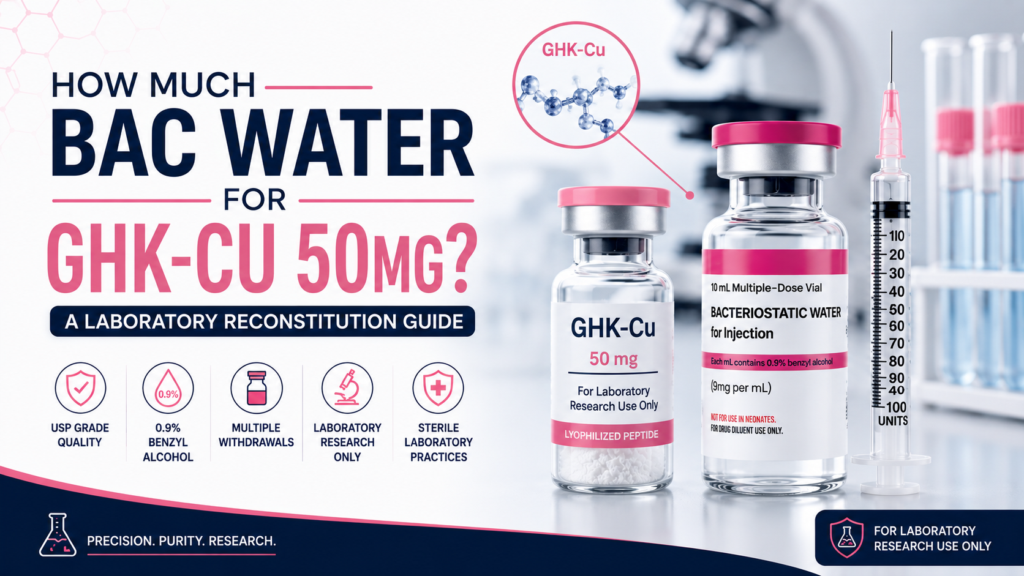
GHK-Cu (Copper Tripeptide-1) is a research peptide widely studied for its potential role in cellular biology, tissue regeneration, and wound-healing research. It is commonly supplied as a lyophilized (freeze-dried) powder that requires reconstitution before laboratory use. Understanding how much bac water for GHK-Cu 50mg is appropriate helps researchers prepare solutions with consistent concentrations for experimental applications.
Bacteriostatic water is sterile water containing 0.9% benzyl alcohol, which inhibits bacterial growth during repeated withdrawals from the same vial. Because of its preservative properties, it is frequently used in research laboratories where multiple measurements may be taken from a single reconstituted vial.
Researchers should always use sterile equipment and follow established laboratory procedures throughout the reconstitution process.
There is no single required volume of bacteriostatic water for a 50mg vial of GHK-Cu. The amount selected depends on the desired concentration for the laboratory protocol and the precision needed for subsequent measurements.
Many laboratories choose volumes such as 5 mL, 10 mL, or other measured amounts that simplify concentration calculations and improve consistency across experiments. The chosen volume does not change the peptide itself but determines the final concentration of the research solution.
Before beginning any study, researchers should calculate the desired concentration and prepare the solution accordingly.
GHK-CU research requires Only Genuine Hospira® Bacteriostatic Water with verified 0.9% benzyl alcohol maintains sterility and stability. Avoid Amazon “reconstitution solutions” which lack preservative and risk contamination and peptide degradation.
Use the Peptide Reconstitution Calculator to calculate peptide concentration and solution volume based on the amount of GHK-Cu and bacteriostatic water used in a laboratory preparation.
The calculator provides a convenient way to perform concentration calculations and helps researchers maintain consistency when preparing GHK-Cu solutions for laboratory research.
Formulas:
Concentration (mg/mL) = Peptide Amount (mg) ÷ BAC Water (mL)
Volume (mL) = Desired Amount (mg) ÷ Concentration (mg/mL)
Units = Volume (mL) × 100
To help maintain sample quality, laboratories generally follow these practices:
Following standardized procedures helps support reproducible laboratory research.
Determining how much bac water for GHK-Cu 50mg depends on the concentration required for a specific research protocol rather than a universal mixing volume. Careful calculations, sterile handling techniques, and proper storage contribute to reliable laboratory results and consistent experimental conditions.
Note: GHK-Cu and bacteriostatic water are intended for laboratory research purposes only. They are not intended for human or veterinary use.
Sign up and We'll Generate a Personal VIP Coupon Code That's Yours For Life — No Expiry, No Limits - Use it on Every Order.