
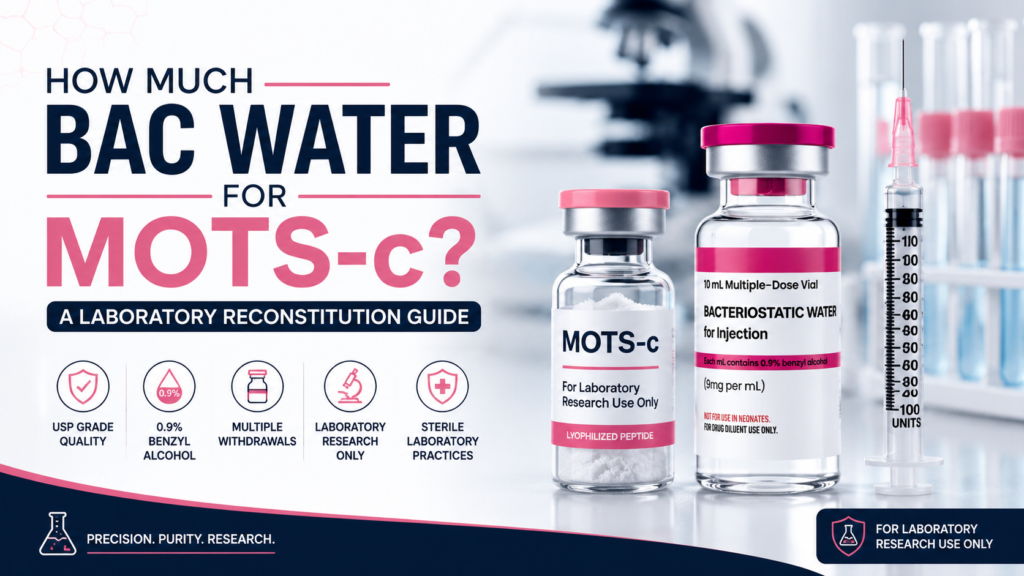
MOTS-c is a mitochondria-derived peptide that has attracted growing interest in metabolic and cellular research. Before it can be used in laboratory studies, researchers typically reconstitute the lyophilized peptide with bacteriostatic water to create a stable research solution. Understanding how much bac water for MOTS-c to use helps maintain consistency across laboratory procedures while supporting accurate concentration calculations.
Bacteriostatic water is sterile water containing 0.9% benzyl alcohol, which helps inhibit bacterial growth during multiple withdrawals from the same vial. This makes it a common choice for laboratory research requiring repeated access to a reconstituted peptide. Researchers should always use sterile equipment and follow established laboratory protocols during the reconstitution process.
There is no universal volume of bacteriostatic water that must be added to MOTS-c. The appropriate amount depends on the peptide quantity in the vial and the concentration required for the specific research protocol.
Many laboratories choose volumes such as 1 mL, 2 mL, or 5 mL because these measurements simplify concentration calculations and improve consistency between experiments. Regardless of the selected volume, the goal is to create a solution that supports accurate laboratory measurements without altering the peptide itself.
Use the Peptide Reconstitution Calculator to calculate peptide concentration and solution volume based on the amount of MOTS-c and bacteriostatic water used in a laboratory preparation.
The calculator provides a convenient way to perform concentration calculations and helps researchers maintain consistency when preparing MOTS-c solutions for laboratory research.
Formulas:
Concentration (mg/mL) = Peptide Amount (mg) ÷ BAC Water (mL)
Volume (mL) = Desired Amount (mg) ÷ Concentration (mg/mL)
Units = Volume (mL) × 100
When preparing MOTS-c for research, laboratories generally follow these best practices:
Proper handling helps preserve sample integrity throughout the research period.
Determining how much bac water for MOTS-c depends on the desired research concentration rather than a single standardized volume. Careful planning, accurate calculations, and sterile laboratory techniques contribute to consistent and reproducible research outcomes. By following appropriate reconstitution practices, laboratories can prepare MOTS-c solutions that support reliable scientific investigations.
Note: Bacteriostatic water and MOTS-c are intended for laboratory research purposes only. They are not intended for human or veterinary use.
Sign up and We'll Generate a Personal VIP Coupon Code That's Yours For Life — No Expiry, No Limits - Use it on Every Order.