
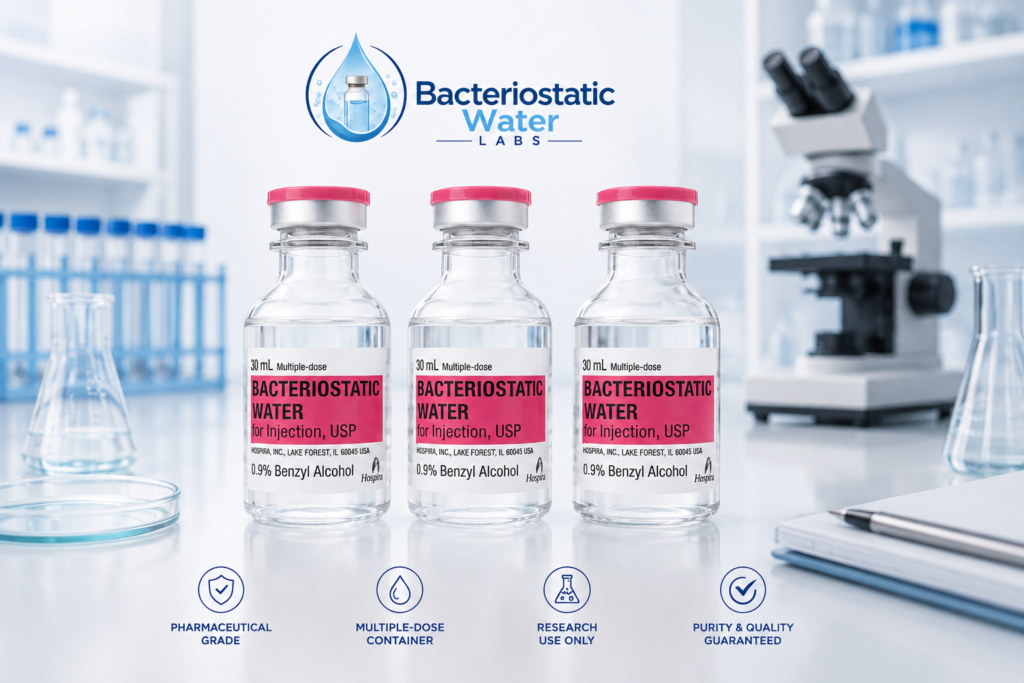
Selecting the appropriate bacteriostatic water is an important step in maintaining consistency and reliability during laboratory research. While bacteriostatic water is widely used in research settings, choosing the right product involves more than simply selecting a vial size. Researchers should evaluate several factors, including quality standards, packaging, storage requirements, and compatibility with their laboratory protocols. Understanding these considerations helps support accurate handling practices and efficient laboratory workflows.
Bacteriostatic water is sterile water for injection that contains 0.9% benzyl alcohol as a preservative. Researchers puncture the vial, and the preservative inhibits bacterial growth, allowing them to perform multiple withdrawals while following proper aseptic techniques.
This feature distinguishes bacteriostatic water from preservative-free sterile water, which researchers typically use for single-use applications.
When selecting bacteriostatic water, researchers should review the product specifications provided by the manufacturer or supplier. Manufacturers produce products that meet recognized pharmaceutical standards, such as United States Pharmacopeia (USP) specifications, to satisfy established quality requirements for sterility and composition.
Reviewing product documentation and labeling can help ensure the solution aligns with laboratory quality expectations.
Laboratories often select vial sizes based on expected usage and research workflow. Smaller vials may be appropriate for projects requiring limited quantities, while larger multi-dose vials can reduce the frequency of opening new containers during ongoing laboratory procedures. Choosing the correct size can also help minimize unnecessary waste while supporting organized inventory management.
Proper storage plays an important role in preserving product integrity. Bacteriostatic water should be labd according to the manufacturer’s recommendations. Typically at controlled room temperature and away from excessive heat, freezing conditions, or direct sunlight. Researchers should also inspect each vial before use and avoid using products that show signs of contamination, discoloration, or damaged packaging.
Every research project has unique procedural requirements. Reviewing product labeling, quality documentation, expiration information, and packaging details helps researchers select bacteriostatic water that supports their laboratory protocols. By evaluating these factors carefully, laboratories can maintain organized research practices while ensuring that the selected product meets the intended scientific application.
Use the Peptide Reconstitution Calculator to calculate peptide concentration and solution volume based on the amount of peptide and bacteriostatic water used in a laboratory preparation.
The calculator provides a convenient way to perform concentration calculations and helps researchers maintain consistency when preparing peptide solutions with bacteriostatic water. Researchers should use the calculator alongside product documentation and established laboratory procedures when planning laboratory preparations.
Formulas:
Concentration (mg/mL) = Peptide Amount (mg) ÷ BAC Water (mL)
Volume (mL) = Desired Amount (mg) ÷ Concentration (mg/mL)
Units = Volume (mL) × 100
Sign up and We'll Generate a Personal VIP Coupon Code That's Yours For Life — No Expiry, No Limits - Use it on Every Order.