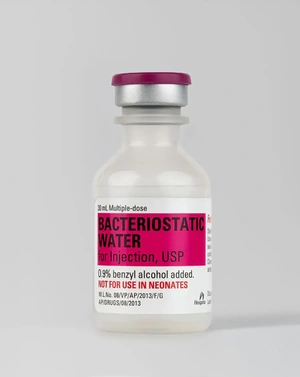
Researchers often choose Hospira bacteriostatic water for research when laboratory procedures require multiple withdrawals from the same vial. Understanding the appropriate Hospira bacteriostatic water dose for a specific research protocol depends on the laboratory’s established procedures and experimental requirements. Its standardized formulation includes a bacteriostatic preservative that helps maintain solution integrity after researchers puncture the vial, provided they follow proper aseptic techniques. Understanding how this formulation supports multi-dose applications can help laboratories select appropriate supplies for scientific workflows.
Hospira bacteriostatic water consists of sterile water for injection containing 0.9% benzyl alcohol as a bacteriostatic preservative. After researchers puncture the vial, the preservative helps inhibit bacterial growth, allowing them to perform multiple withdrawals while maintaining appropriate laboratory handling practices. This characteristic distinguishes bacteriostatic water from preservative-free sterile water, which laboratories generally reserve for single-use applications.
The preservative supports multi-dose use, but it does not replace proper laboratory procedures. Researchers should disinfect the vial stopper before each withdrawal, use sterile equipment, and minimize unnecessary handling to reduce the risk of contamination. Following established aseptic techniques helps preserve product quality throughout its intended laboratory use.
Many research projects require repeated access to sterile solutions during ongoing experiments. Multi-dose capability allows researchers to obtain multiple withdrawals from a single vial instead of opening several single-use containers. This approach can improve workflow efficiency, simplify inventory management, and reduce material waste while maintaining standardized laboratory practices.
Manufacturers produce Hospira bacteriostatic water to meet United States Pharmacopeia (USP) specifications for sterility and composition. Researchers should lab the product according to the manufacturer’s recommendations and inspect each vial before use. Proper storage, careful handling, and routine inspection help maintain product integrity during laboratory research.
Use the Peptide Reconstitution Calculator to calculate peptide concentration and solution volume based on the amount of peptide and bacteriostatic water used in a laboratory preparation.
The calculator provides a convenient way to perform concentration calculations and helps researchers maintain consistency when preparing peptide solutions with bacteriostatic water. Researchers should follow the product documentation and their laboratory’s validated procedures when determining appropriate preparation parameters.
Formulas:
Concentration (mg/mL) = Peptide Amount (mg) ÷ BAC Water (mL)
Volume (mL) = Desired Amount (mg) ÷ Concentration (mg/mL)
Units = Volume (mL) × 100
Hospira bacteriostatic water supports multi-dose laboratory applications through its preservative system, standardized formulation, and compliance with recognized quality standards. By combining appropriate product selection with proper aseptic handling and storage practices, research laboratories can maintain consistent procedures and support reliable scientific outcomes.
Note: This article is intended for educational and scientific purposes only. It provides general information about Hospira bacteriostatic water for laboratory research and does not offer medical or clinical guidance.
Sign up and We'll Generate a Personal VIP Coupon Code That's Yours For Life — No Expiry, No Limits - Use it on Every Order.